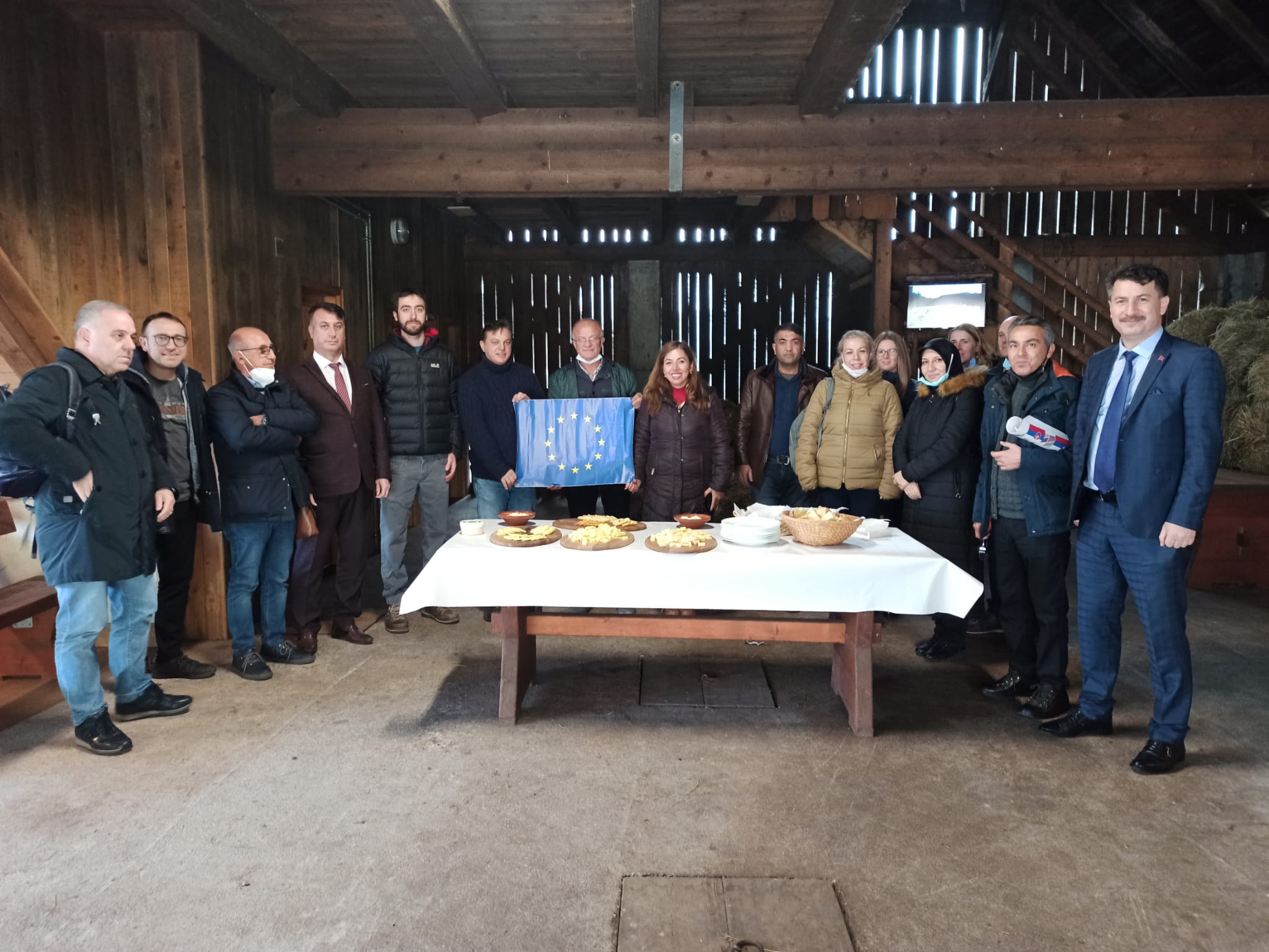
The increasing demand for traditional cheeses in Turkey and EU countries, as well as the demand beyond the regions where they are produced, requires the production technologies and hygiene standards of regional cheeses to be developed to the highest level.
The aim of the project is to contribute to the reduction of regional differences in the production technologies and hygiene standards of traditional cheeses in EU member and candidate countries through ICT-based educational methodologies.
The project titled "Research on the Production Technology and Standards of Traditional Cheeses in the Light of the European Union," with the short name BestCHEESE and project number 2019-1-TR01-KA202-077415, was approved by the Turkish National Agency under the 2019 Call for Proposals and has received grant support from the European Commission. This project is part of the Erasmus+ Program, under the Strategic Partnerships for Innovation and the Exchange of Good Practices.
This program, prepared under the coordination of the Eskişehir Directorate of Agriculture and Forestry with contributions from Italy, Slovenia, Slovakia, Ankara University, and the Batman Directorate of Agriculture and Forestry, has been developed as an accessible educational platform for anyone who wants to produce traditional cheeses or gain knowledge about them.
In our country, traditional cheeses, whose production methods and consumption practices have been passed down through generations for centuries, suffer from the lack of a standardized production process. Over time, this has led to a decline in both their quality and production quantity, and in some cases, the loss of certain types of regional cheeses.
The educational platform provides brief information on the following topics: workplace requirements in traditional cheese production, production processes, manufacturing defects, flowcharts of the production processes of certain regional cheeses produced in Turkey and EU countries, production technologies, the use of starter cultures, raw material selection, maturation processes, historical development, consumption habits, and labeling and marketing requirements.
Through the activities within the scope of the project, innovative methods and the advantages and disadvantages of practices in different EU countries were discussed around a table. At the end of the project, common educational modules were created in 5 different languages on the ICT platform, applicable in all countries. As a result, an innovative and effective study was carried out that will lead to institutional modernization by aligning production, quality, and control standards across different EU countries with the same training.
The experiences and information gained from different countries were compiled by subject matter experts. Through mutual information exchange in field and office studies, ICT-based training modules have been developed that can be used by Turkey, EU countries, and all countries around the world. As is well known, one of the EU's founding objectives is to reduce regional differences and ensure the free movement of goods.
In EU member or candidate countries, to ensure the highest level of food safety, production technologies for traditional cheeses, and hygiene requirements, it is crucial for the technical personnel working in the field (food inspectors, trainers, primary producers of traditional foods, and food company employees) to be well-informed through common modules. As a result, bringing quality and control standards closer to each other in different EU countries through the same training requires the joint creation of a control mechanism.
Starting from this point, we aimed to fulfill our responsibility by contributing to Turkey, EU countries, and all countries around the world. We hope that this training will be beneficial to all participants.